You Don't Need to Speak Sanskrit to Feel It: Why Americans Are Falling Hard for Indian Devotional Music
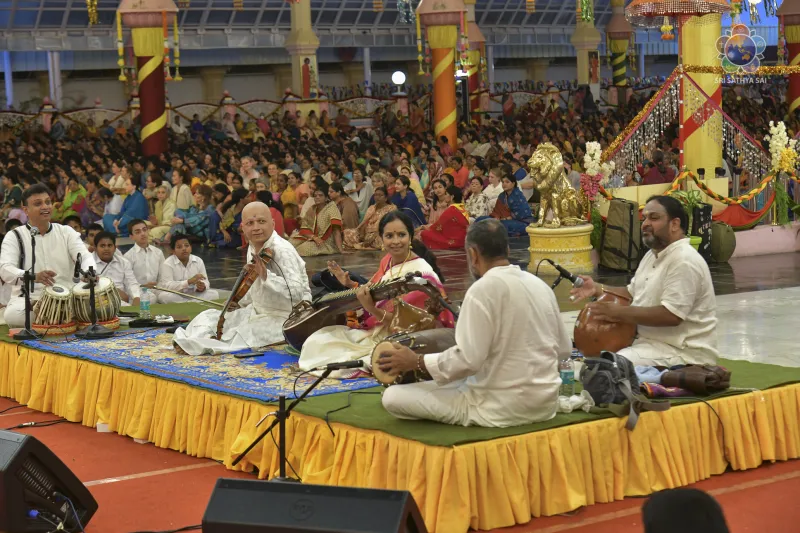
Photo: Indian devotional choir performance concert audience emotional, via content.sssmediacentre.org
After a recent Bangalore Choir performance in Austin, Texas, a woman named Carolyn — a retired high school music teacher from Round Rock — stood near the exit holding a program she'd clearly been gripping for the better part of two hours. The ink from the song titles had smudged against her palm. She hadn't understood a word of the Sanskrit and Kannada pieces on the setlist. She also hadn't stopped crying since the third song.
"I kept waiting for it to make sense," she said, laughing at herself. "But it just... kept getting inside me somehow."
Carolyn is far from alone. Across the US, audiences with zero background in Indian classical traditions are showing up to devotional music performances — and leaving completely undone. The phenomenon is real, it's growing, and it says something fascinating about the way human beings are wired for spiritual sound.
The Language Barrier That Isn't Really a Barrier
Here's the thing about devotional music, whether it's a Carnatic kriti, a Kannada bhajan, or a Sanskrit shloka set to melody: the emotional architecture of the piece isn't really in the words. It's in the intervals, the microtonal bends, the deliberate pacing of tension and release. Musicologists have a term for this — they call it "emotional universality" — and it's the reason a listener in Nashville can feel the weight of a composition written in 16th-century South India without cracking open a translation guide.
Dr. Priya Moorthy, an ethnomusicologist who has studied cross-cultural audience responses to Indian classical music, puts it plainly: "Devotional ragas are engineered, over centuries, to produce specific emotional states. Bhairavi is meant to evoke longing and tenderness. Kalyani carries a brightness that reads as spiritual elevation. These aren't cultural codes — they're human ones. The body responds before the brain gets involved."
That's the piece of the puzzle that tends to surprise Western listeners most. They expect to need context. They expect to feel like outsiders. Instead, they feel like the music already knew them.
What Bangalore Choir Audiences Are Actually Saying
We've been collecting informal feedback from American audience members at Bangalore Choir events over the past year, and the language people reach for is remarkably consistent. Words like grounding, expansive, timeless, and — this one comes up a lot — familiar, somehow appear again and again.
Marcus, a software developer from Atlanta who attended a Bangalore Choir event last fall, described the experience as "like stumbling into a conversation that was already about everything that matters." He'd gone because a coworker dragged him along. He's now attended four performances.
Then there's Jennifer, a yoga instructor from Portland who had been exposed to Sanskrit chanting through her practice but had never heard it performed in a full choral context. "In yoga class, chanting always felt a little performative to me, honestly," she admitted. "But hearing it done by a group that's been living inside this tradition their whole lives — it's completely different. It lands differently. It has weight."
That word — weight — is interesting. What Jennifer is describing is the difference between aesthetic borrowing and genuine transmission. Bangalore Choir isn't delivering a polished cultural export. They're bringing something intact.
The Devotional Gateway Drug Effect
There's a pattern that keeps emerging among new American fans of Indian classical music: devotional performance is almost always where the journey begins. Not instrumental Carnatic — which is extraordinary but can feel technically demanding for untrained ears. Not film music — which is accessible but doesn't carry the same spiritual gravity. Devotional choral music seems to be the entry point that opens the door to everything else.
"It's the emotional hook," says Ranjani Krishnaswamy, one of Bangalore Choir's lead soloists. "When someone hears a piece like Thyagaraja's Nagumomu performed live, they don't need to know who Thyagaraja was or what the Telugu text means. They feel the devotion. And once you feel that, you want to understand it. You start asking questions. You start listening more."
That curiosity loop — feel it first, understand it later — is actually a pretty healthy way to fall in love with any musical tradition. It's how most of us discovered the music we care most deeply about. You didn't study the blues before you felt it. You didn't read about gospel before it moved you.
Why Spiritual Resonance Doesn't Need a Shared Religion
One of the more counterintuitive aspects of this whole phenomenon is that the audiences being most visibly moved by Hindu devotional music are often not Hindu. They're Christians, agnostics, secular Jews, lapsed Catholics — people who, on paper, have no stake in the theological content of these pieces.
And yet.
What researchers who study religious music across cultures have consistently found is that the structure of devotional music — its repetition, its call-and-response patterns, its use of sustained tones and deliberate silence — activates something in the nervous system that doesn't check your religious ID at the door. It's connected to what some neuroscientists call the "awe response," a physiological state involving slowed heart rate, heightened attention, and a kind of productive emotional vulnerability.
In other words, you don't need to be praying to something to experience the state that prayer music is designed to produce. The music does the work regardless.
For Bangalore Choir, this isn't just an interesting academic footnote — it's the whole point. The ensemble has always understood their mission as one of genuine connection, not cultural demonstration. They're not asking American audiences to become students of Carnatic tradition before they're allowed to be moved by it. They're simply performing with full sincerity and trusting that sincerity travels.
What Comes Next
The growing American appetite for devotional music from Bangalore Choir and groups like them is starting to reshape how Indian classical ensembles think about programming, venue selection, and audience engagement. There's a real conversation happening right now about how to honor the sacred roots of this music while making space for the genuinely curious newcomer who walked in knowing nothing and left knowing something they can't quite name yet.
For Carolyn, the retired music teacher from Round Rock with the smudged program, that nameless something was enough — more than enough, actually.
"I've been to a lot of concerts in my life," she said before heading out into the Austin night. "That's the first time I've ever felt like the music was singing at me on purpose. Like it had something specific to say to me."
Honestly? We think it did.