Campus Stages Are Changing: How Indian Classical Vocalists Became the Most Wanted Singers in American Higher Education
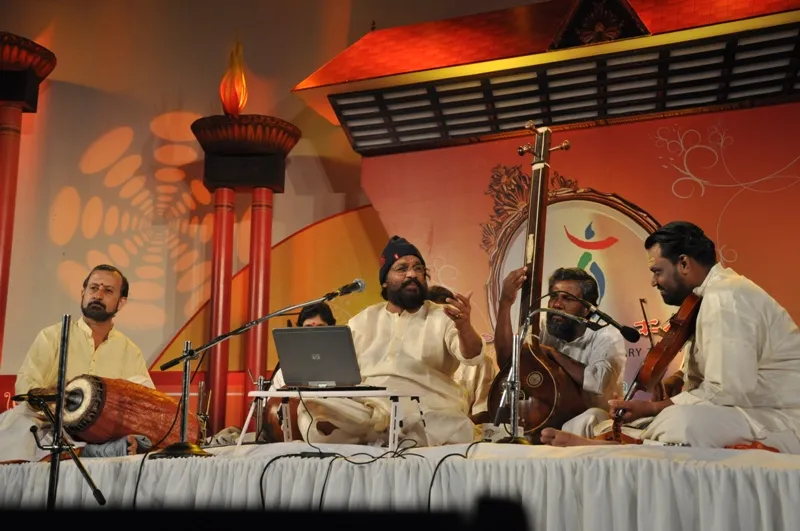
Photo: Rakesh S from Bangalore, India, CC BY-SA 2.0, via Wikimedia Commons
For most of the twentieth century, the path into an elite American music program ran through a pretty familiar set of checkpoints: classical Western training, maybe some jazz, a few years of piano theory, and a polished audition piece — preferably something from the Romantic era. That formula held steady for decades.
But walk into a music department orientation at a growing number of US universities today and you'll notice something different. Alongside the violinists and the opera hopefuls, there are singers who trained under gurus in Chennai and Mysore. Students who can navigate a Bhairavi raga with the same fluency that their classmates bring to a Bach chorale. And increasingly, they didn't stumble into these programs by accident — they were recruited.
The Shift Nobody Saw Coming
The trend picked up serious momentum in the years following the pandemic, when music departments across the country began reckoning with a hard truth: their curricula were narrow in ways that were hurting their students. Theory classes built entirely around Western harmonic structures left graduates unprepared for a music industry that had gone genuinely global. Ensemble programs that defaulted to European choral traditions were struggling to reflect — or attract — the diverse student bodies that universities were working hard to build.
Indian classical music, with its staggering theoretical depth, its intricate rhythmic systems, and its centuries-old tradition of oral transmission, started looking less like an exotic elective and more like a structural solution.
"We realized we were teaching music history and theory as if the rest of the world had been humming along in the background," says one music department chair at a mid-sized Midwestern university who asked not to be named while recruitment conversations are ongoing. "Carnatic and Hindustani traditions have entire systems of modal thinking, of microtonal awareness, of rhythmic complexity that our students had zero vocabulary for. Bringing in singers who live inside those traditions — that changes the room."
What Indian Classical Training Actually Brings to the Table
It helps to understand what makes a Carnatic or Hindustani-trained vocalist genuinely different as a musical mind, not just as a performer.
The training is long — often beginning in childhood and continuing for years under a single guru — and it builds a kind of internalized theoretical knowledge that Western conservatory training approaches differently. Raga grammar, shruti (microtonal pitch relationships), tala cycles, improvisation within strict structural rules — these aren't concepts a Carnatic vocalist reads about in a textbook. They're lived, sung, corrected, and re-sung until they become instinct.
For university music programs trying to teach concepts like modal harmony, non-Western rhythm, or ornamentation, a student who has spent a decade navigating these ideas inside a living tradition is an extraordinary resource — both for faculty and for fellow students.
Priya Venkataraman, a third-year music student at a Northeast liberal arts college who trained with a Carnatic vocal teacher in Bangalore before relocating to the US, describes the dynamic bluntly. "My professors will be explaining a concept about pitch bending or melodic ornamentation and I'll already have fifteen years of muscle memory around it. But the flip side is that my classmates are showing me harmonic structures I've never had to think about. It genuinely goes both ways."
The Admissions Angle
What's particularly notable about this trend is that it isn't just happening organically. Admissions offices at several universities — particularly those with strong arts programs — have begun proactively identifying and reaching out to Indian classical vocalists, sometimes through diaspora community networks, sometimes through music academies in cities like Bangalore, Chennai, and Hyderabad.
For Bangalore Choir, which has served as an informal pipeline for connecting Indian classical vocal talent with American audiences and institutions, the uptick in inquiries from university representatives has been noticeable. Several of our members and alumni have fielded calls from music program directors who found them through performances or community events.
"It used to be that someone with my background had to explain what Carnatic music even was before we could talk about whether I was a good fit for a program," says one Bangalore Choir alumni member who is now completing a graduate degree in ethnomusicology in California. "Now I'm getting emails from department heads who have clearly done their homework. They're asking specific questions about my training lineage, my raga repertoire. That's new."
Reshaping the Ensemble Experience
The impact isn't limited to theory classrooms. University choral ensembles and world music groups are being transformed by the presence of Indian classical vocalists in ways that directors say are hard to overstate.
Gamaka — the ornamental slides and oscillations that are central to Carnatic vocal style — doesn't translate directly into Western choral notation. When a trained Carnatic singer joins an ensemble, directors have to rethink how they communicate musical ideas, how they score arrangements, and how they think about blend versus individual expression. That creative friction, most directors will tell you, produces better music and better musicians.
One choral director at a large state university in the South described introducing a Carnatic vocalist into his chamber ensemble as "like adding a new color to a palette I didn't know was incomplete." His ensemble has since performed a commissioned piece that weaves Carnatic melodic structure into a Western choral framework — and the recording has circulated widely in music education circles.
The Cultural Shift Running Underneath
There's a bigger story here that goes beyond curriculum and ensemble logistics. The recruitment of Indian classical vocalists into American higher education reflects a broader cultural reassessment of what musical excellence looks like and where it comes from.
For generations, the implicit assumption embedded in US music education was that the Western European tradition represented the pinnacle of formal musical achievement. Everything else was folk music, world music, ethnomusicology — interesting, perhaps, but not quite serious in the same way. That assumption is crumbling, and it's crumbling partly because of performers and educators who have spent years demonstrating, through sheer quality and rigor, that other traditions demand equal intellectual and artistic respect.
Indian classical vocal training — with its demanding guru-shishya pedagogy, its vast theoretical architecture, and its emphasis on spontaneous creativity within form — is one of the most powerful arguments against that old hierarchy.
What This Means for the Community
For the Indian classical music community in the US — including groups like Bangalore Choir who have been doing the slow, steady work of building American audiences for this art form — the university recruitment trend feels like a meaningful validation. Not that the music ever needed external validation. But institutional recognition has a way of creating infrastructure: scholarships, performance opportunities, research funding, and cultural legitimacy that helps the next generation of singers build sustainable lives around this art.
The students being recruited today will become the music educators, the ensemble directors, and the composers of tomorrow. And when they build their curricula and their programs, they'll build them with Carnatic ragas and Hindustani thumris sitting comfortably alongside Bach and Beethoven — not as exotic additions, but as foundational material.
That's not a small thing. That's the sound of American music education finally catching up to what the music always knew.