Why Your Brain Reacts to a Raga Completely Differently Than a Pop Chord Progression
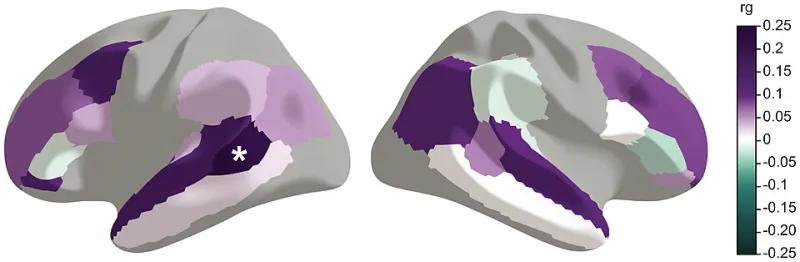
Photo: Authors of the study: Else Eising https://orcid.org/0000-0001-9819-1260, Nazanin Mirza-Schreiber, Eveline L. de Zeeuw, Carol A. Wang, Dongnhu T. Truong, Andrea G. Allegrini, Chin Yang Shapland https://orcid.org/0000-0002-5797-1241, Gu Zhu, Karen G
Something strange happens to a lot of Americans the first time they sit in front of a live Carnatic performance. They can't explain it. They don't know the language. They've never studied the theory. But somewhere around the third or fourth minute, something shifts — a tightness in the chest, a wave of something that feels almost like grief but isn't quite, or an unexpected sense of expansiveness, like a window opening in a room they didn't know was closed.
This isn't mysticism. According to a growing body of research at the intersection of neuroscience and musicology, what those listeners are experiencing is the result of a fundamentally different emotional architecture — one that ragas have been built on for over two thousand years, and one that the Western brain is, apparently, surprisingly receptive to.
The Major/Minor Shortcut — And Its Limits
Most Americans grow up absorbing a pretty simple emotional grammar in music. Major keys feel happy. Minor keys feel sad. That's the shorthand, anyway. And while Western music theory is obviously far more nuanced than that bumper-sticker version, the reality is that the major/minor framework does create a kind of emotional two-lane highway in the brain. Listeners learn the road early and travel it automatically.
"What we see in neuroimaging studies is that Western listeners process major and minor tonality very quickly, almost reflexively," explains Dr. Priya Venkataraman, a music cognition researcher who has consulted with several American university music programs on cross-cultural listening. "The emotional response is real, but it's also somewhat conditioned. The brain has learned the shortcut."
Ragas don't offer that shortcut. Instead, they present the brain with something it has to work through differently — and that effort, counterintuitively, may be exactly what makes the emotional payoff so striking.
What a Raga Actually Does to Your Nervous System
A raga isn't a scale, exactly, though it contains one. It's a complete emotional and melodic framework — a set of rules about which notes to emphasize, which to approach from above or below, which intervals to linger on, and crucially, what time of day or season the piece belongs to. Bhairavi, for example, is traditionally a morning raga associated with devotion and a particular quality of longing. Yaman carries an evening quality — expansive, slightly melancholic, but with an undercurrent of serenity. Darbari Kanada moves slowly, deliberately, and tends to produce what listeners consistently describe as a deep, almost physical heaviness.
Researchers studying emotional responses to these ragas using both self-reporting and physiological markers — heart rate variability, skin conductance, cortisol levels — have found something interesting: the emotional states they produce are consistent across listeners, including listeners with no prior exposure to Indian classical music.
"We ran a study with participants who had never heard Carnatic or Hindustani music before," says music therapist and researcher Marcus Webb, based in Portland, Oregon. "We played them excerpts from several different ragas without any context. The emotional clustering in their responses was remarkably consistent — not identical to how Indian listeners described the same pieces, but not random either. There were clear patterns."
The leading theory? Ragas engage what researchers call a slower, more exploratory emotional processing pathway. Instead of triggering an immediate, learned response the way a familiar chord progression does, they invite the brain into a kind of sustained emotional attention — which activates deeper limbic system engagement over time.
The Time Factor
One of the most fascinating aspects of raga-based emotion is that it's not front-loaded. Western pop music is famously engineered for an immediate hook — something that grabs you in the first eight seconds. Ragas work on a completely different timeline.
The alap, the slow, unmetered opening section of a classical performance, can last anywhere from a few minutes to half an hour. During this phase, the performer introduces the raga's emotional world gradually, almost the way you'd describe a landscape to someone who can't see it yet. By the time the rhythmic composition begins, a skilled listener — or even an unprepared but attentive one — has been thoroughly saturated in a specific emotional atmosphere.
"It's closer to what happens during certain meditation practices than what happens when you hear a song," says Webb. "The sustained attention required actually changes your neurological state. You're not just feeling an emotion — you're inhabiting one."
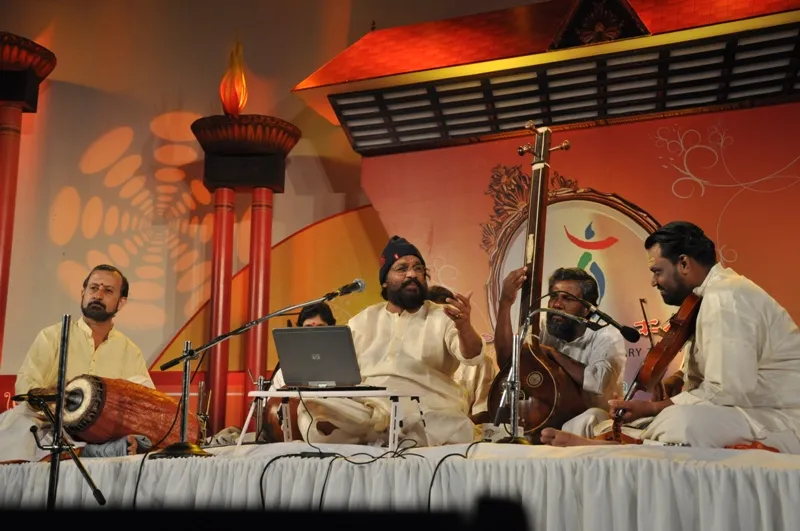
American audiences who've attended Bangalore Choir performances have described this experience in almost identical terms, even without any prior coaching on what to expect. "I kept waiting for it to 'start,'" said one audience member after a recent show in Chicago. "And then I realized it had started. I was already somewhere completely different emotionally and I hadn't noticed the transition."
Specific Ragas, Specific Effects
The mapping gets even more precise when you look at individual ragas. Here's a rough sketch of what the research and consistent listener reports suggest:
Bhairavi tends to produce feelings of tender sadness, devotion, and what several American listeners have described as "a kind of beautiful ache." It's often the raga that makes first-time Western listeners cry without understanding why.
Yaman consistently generates feelings of longing combined with a sense of peaceful openness — several listeners have compared it to the emotional quality of watching a sunset alone.
Darbari Kanada produces something heavier and more internal — introspection, gravity, a slowing of mental activity that some music therapists are exploring for anxiety reduction.
Bhupali tends to generate warmth and a feeling of uncomplicated contentment — it's one of the ragas most likely to produce smiling in listeners who don't know why they're smiling.
None of these effects require cultural context to occur. That's the part that keeps researchers genuinely interested.
Why Cross-Cultural Emotional Resonance Matters Right Now
In a cultural moment when the conversation about music is increasingly global — when a kid in Ohio is as likely to be listening to K-pop or Afrobeats as country radio — the science of cross-cultural emotional resonance isn't just academically interesting. It has real implications for how we think about what music is actually doing.
For groups like Bangalore Choir, it reframes the entire question of audience. The assumption that Indian classical vocal music requires a culturally initiated audience turns out to be, at least in part, a myth. The emotional infrastructure is already there. The brain doesn't need a map — it just needs to be given enough time and quiet to find its own way in.
And if the neuroscience is right, what American audiences are experiencing when they sit with a raga for the first time isn't confusion slowly replaced by appreciation. It's something more immediate than that — a genuine emotional encounter with a system that's been refined specifically to produce it, working exactly as designed, across every border it crosses.